
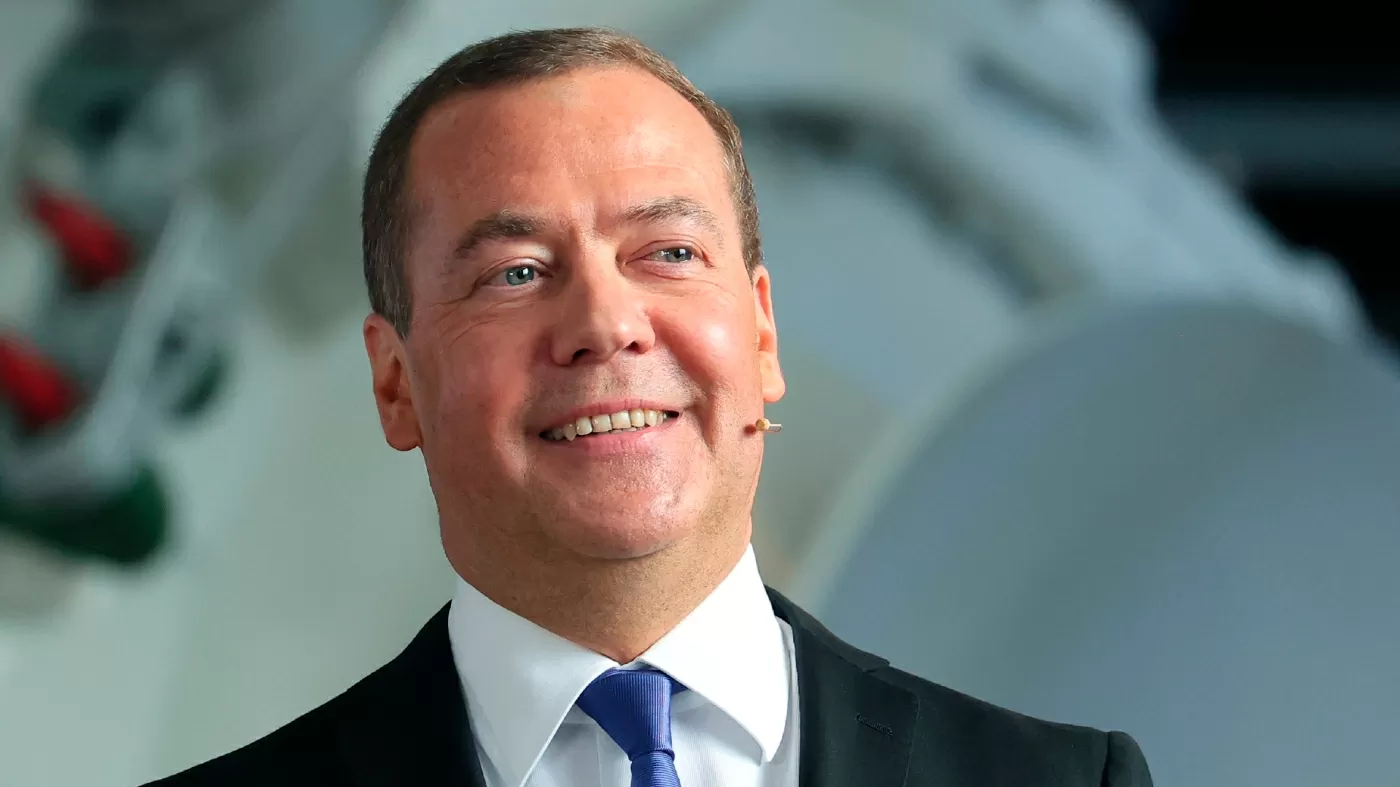
An adviser to Russian President Vladimir Putin has made a bold statement regarding the recent ceasefire deal between the United States and Iran. Dmitry Medvedev, the deputy chair of the Security Council of Russia, stated that Iran’s nuclear weapon is not a physical weapon, but rather the strategic location of the Strait of Hormuz. He believes that this waterway has unlimited potential to be used against the U.S. and its allies.
The Strait of Hormuz, located between Iran and Oman, is a narrow waterway that connects the Persian Gulf to the Arabian Sea. It is a vital route for global oil transportation, with one-fifth of the world’s oil passing through it. This makes it a crucial chokepoint for the global economy and a potential target for any country seeking to disrupt the flow of oil.
Medvedev’s statement comes after the U.S. and Iran reached a two-week ceasefire deal, which has been met with mixed reactions from the international community. While some see it as a step towards de-escalation of tensions between the two countries, others, like Medvedev, see it as a temporary solution that does not address the root cause of the conflict.
In his statement, Medvedev emphasized that the U.S. should not underestimate the power of the Strait of Hormuz. He believes that Iran has the ability to control this waterway and use it as a weapon against the U.S. and its allies. This is not the first time that Iran has threatened to close the Strait of Hormuz in response to U.S. sanctions and military actions in the region.
The adviser’s words may seem alarming to some, but they also shed light on the complex dynamics of the ongoing conflict between the U.S. and Iran. It is a reminder that there are other factors at play besides the nuclear deal and that the U.S. must tread carefully in its dealings with Iran.
Medvedev’s statement also highlights the importance of the Strait of Hormuz in global politics and the need for all countries to work together to ensure its safety and stability. Any disruption in the flow of oil through this waterway could have severe consequences for the global economy, affecting not only the U.S. but also other countries around the world.
Furthermore, Medvedev’s words serve as a reminder that the U.S. must consider the interests of other countries, including Russia, when making decisions that affect the Middle East. The U.S. and Russia have had a complicated relationship in recent years, with tensions rising over issues such as Syria and Ukraine. However, Medvedev’s statement shows that Russia is still a key player in the region and cannot be ignored.
In conclusion, Dmitry Medvedev’s statement regarding Iran’s nuclear weapon being the Strait of Hormuz is a stark reminder of the complexities of the ongoing conflict between the U.S. and Iran. It also highlights the importance of this waterway in global politics and the need for all countries to work together to ensure its safety and stability. The U.S. must consider the interests of other countries, including Russia, when making decisions that affect the Middle East. Let us hope that this ceasefire deal is a step towards a lasting resolution of the conflict and that the Strait of Hormuz remains a peaceful and open waterway for the benefit of all nations.
